
How to Improve QA and Automation Hiring Without Wasting Time
Finding the best talent is not easy, especially when you have to choose one among thousands. Your organisation needs a candidate for a QA or automation role. You just posted it on the job listing sites. And then your inbox fills up. Sounds familiar, right?
Profiles look promising, keywords matched, and for a moment, it feels like things are moving fast. But once interviews begin, things slow down. Candidates don’t perform as expected, rounds stretch longer, and somehow you are investing more time than planned.
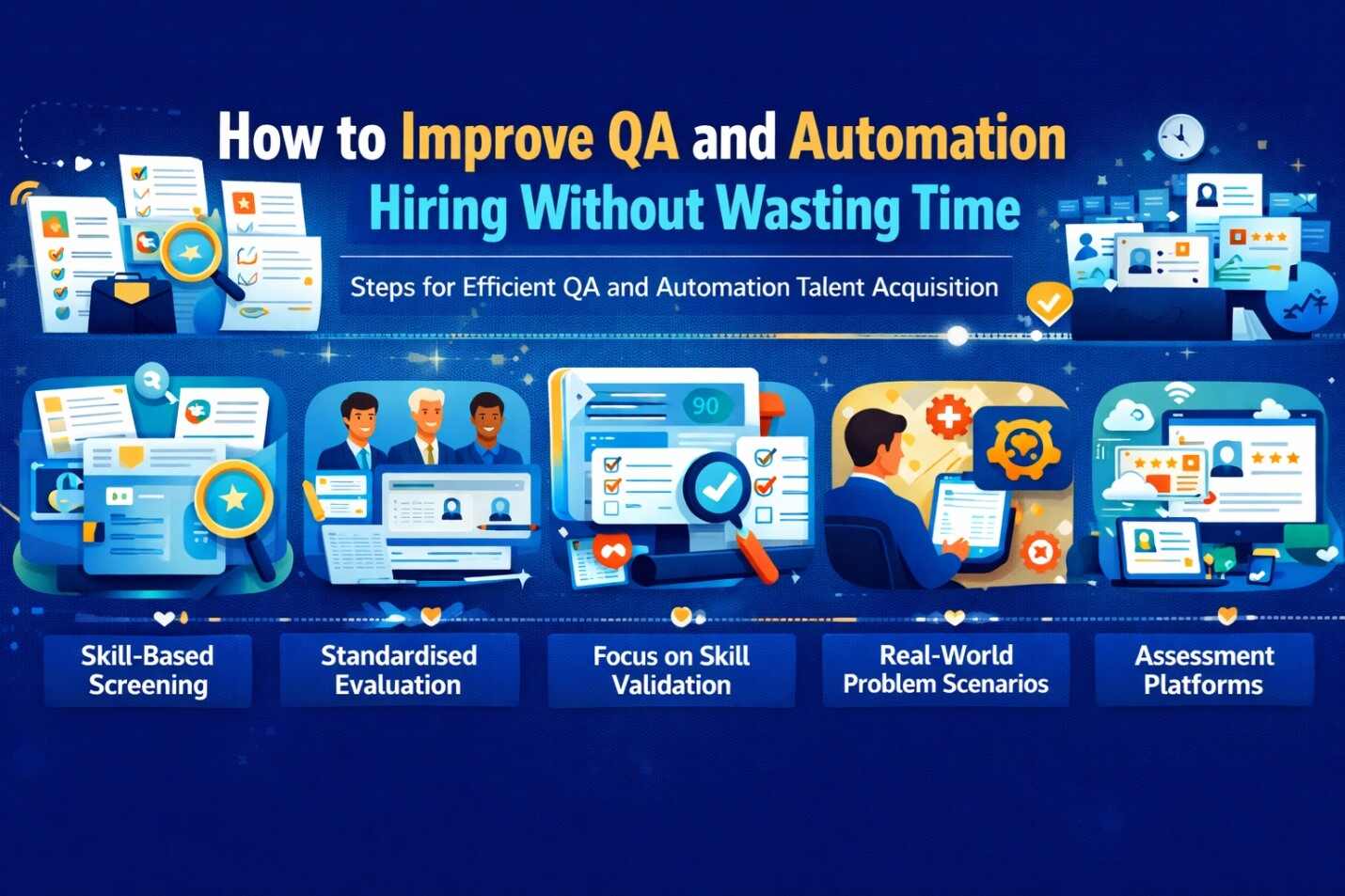
The issue is not effort; it is how the process is built from the start. Don’t worry, with smarter choices, you can improve your hiring process and save time.
Want to Improve QA and Automation Hiring? Here Are the Steps
-
Replace Resume Filtering with Skill-Based Screening
You begin with resumes, hoping to spot the right candidate through listed tools and experience. But most profiles look similar, and that’s where time quietly slips away. Instead of relying only on resumes, introduce early skill-based screening. This helps you immediately separate candidates who can actually perform from those who just list technologies. In QA and Automation hiring, this one shift reduces unnecessary interviews and brings clarity from the beginning.
-
Standardise Evaluation to Avoid Inconsistent Interviews
Interviews often feel long but not productive because every interviewer assesses differently. One focuses on theory, another on tools, and the feedback rarely aligns. The solution is to standardise evaluation criteria. This keeps interviews focused and removes confusion, helping you make quicker and more confident decisions.
-
Focus on Skill Validation Instead of Increasing Interview Rounds
Most IT recruiters often think that more rounds mean better hiring. But in reality, this is not the complete truth. You are actually validating the same thing repeatedly. This slows everything down and frustrates both you and the candidate. When you validate core skills early in the process, you can confidently reduce the number of interview rounds. It speeds up the process without increasing bad hires.
-
Use Real-World Problem Scenarios to Test Practical Ability
A common challenge is that candidates perform well in theory but struggle in real tasks. This happens when the evaluation is too generic. What you can do is introduce real-world QA scenarios, such as test cases, debugging challenges, or automation logic problems. This gives you a clearer picture of how candidates actually work, not just what they know on paper.
-
Introduce Assessment Platforms to Filter Quality Candidates Faster
At some point, it becomes clear that manual screening and unstructured interviews are slowing everything down. This is why technical hiring needs assessment platforms to make things simpler. These platforms allow you to evaluate candidates at scale with consistent benchmarks. They filter out unqualified profiles early, so your team spends time only on candidates who meet the required standard.
If you really think about it, the biggest time loss in hiring comes from unclear evaluation, not a lack of candidates. Once you introduce structure and early validation, everything starts to feel more controlled. You are not rushing, and you are not stuck either. You are simply making better decisions, faster, and that’s what efficient hiring should look like.
Recent Post



Leave a Reply